Hello there!
It’s been a while. More about that below as I tell you about my personal brush with learned helplessness. Maybe you’ve had it too?
Let’s get into it.
When we returned to work in the new year in 2025 (yes, waaaay back then), we were looking forward to a busy year. But just as we were all raring to go, something odd happened. The whole market seemed to freeze. Everything that had been in the ‘definitely starting in Q1’ category, suddenly and inexplicably, was ‘on hold’. Not just one client over here or another one over there. ALL of them. Every. Last. One.
Huh?
In a routine catch-up with my accountant, who specialises in working with professional service firms, I mentioned what we were experiencing, and she said that all her other clients were reporting the same thing.
So, I did what a lot of people do under these sorts of circumstances. I got busy trying to fix it!
I did more marketing, more content, more meetings, more podcasts, more emails, more offer design. But the market didn’t budge.
Zilch.
Nada.
After a few months of trying this thing and that thing, I got exhausted and just went for a proverbial wee lie down.
Which kinda lasted four months.
Obviously, I wasn’t literally just lying down for four months. (Although that sounds quite nice).
No. I was often vertical, waking my dog in the woods, and doing my usual yoga practice (and maybe even slipping in a sneaky daytime class now and again). I also went on a lovely holiday to Biarritz (which I would highly recommend).
And then ANOTHER thing happened.
Just as oddly and as inexplicably as the pipeline froze, it unfroze. I went from leisurely to super busy in the blink of an eye.
Now, don’t get me wrong. I was very happy about this. I love my work, and I enjoy not being stressed. But I had a creeping sense of a lack of agency. That nothing I was doing was making a blind bit of difference either way, so what was the point of all the hard work I’d been doing?
I had a sense that it was all for nought.
And right there, in that still small voice in my head, was learned helplessness.
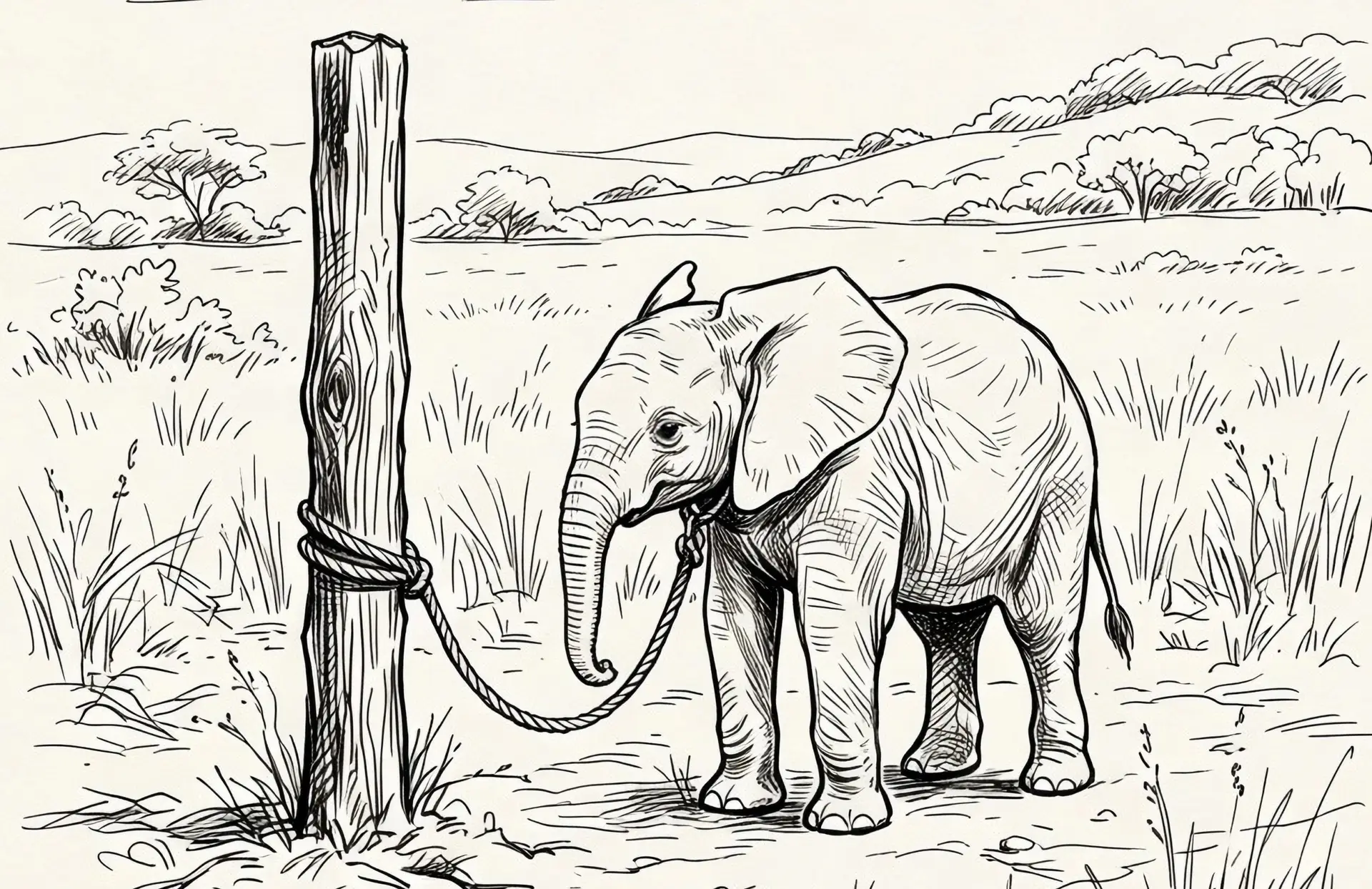
The classic illustration of the learned helplessness phenomenon is a baby elephant tethered by a rope to a metal pole. Young and slight, it pulls and strains to break free until it learns that it can’t be done. So it stops trying. Years pass. The elephant grows, eventually to several tons of muscle that could uproot that pole effortlessly. But it never tests the rope again. The belief formed in weakness survives long into strength. That’s learned helplessness.
In all my busyness in the second half of that year, I was wont to say to pretty much anyone who would listen that I had done nothing to turn the pipeline tap off, and nothing to turn it back on, so I was damned if I had any clue how to run a business anymore.
I repeated this same story at our end-of-year review, and it was there that my trusted colleague, Sarah, told me that this isn’t what happened at all!
Really?
She reminded me that I’d actually spent the summer researching and writing the Executive Readiness Gap report. Research that had taken months of planning, doing and writing with 40 chief people officers. And then we’d put it out into the world, and it has gotten traction in the press and resulted in client work.
Until Sarah reminded me, I had no recollection that this was how the summer had gone. I’d become committed to a story that nothing I did mattered, and I’d erased all facts to the contrary.
How odd!
And that is the thing with learned helplessness. It doesn’t have to be true. In fact, it usually isn’t true.
As humans, we’re all carrying some of this around. Maybe you were told as a child you weren’t smart enough to become a lawyer, or the one time you tried stand-up comedy you bombed, or … [fill in your own personal blank].
But every faulty story needs to be deconstructed at some point because, well, it only gets you so far.
***********
Maybe you’ve found this in your company too?
Because we’ve been so blindsided by pandemics, the dizzying speed of AI’s rise, and geopolitical shenanigans ad infinitum, it can lead us to logically assume that we’ve no idea what’s going to happen next and that it would be futile to try.
And right there, dear one, is learned helplessness on a corporate scale.
The pundits like to say business HATES uncertainty.
Hate it they may do, but here’s the bad news: It’s here, and it isn’t going anywhere soon.
So, it seems we have two choices. We can develop learned helplessness and decide that there’s nothing to do but be buffeted by events beyond our control.
Or we can retire that story and do the eminently doable and satisfying work of anticipating what’s coming next and getting ahead of it.
Once the preserve of the C-suite or strategy department, we’re increasingly helping HR leaders who have realised they can benefit from anticipating what’s next for the workplace and building this into their People Strategy update process.
Maybe, for example, you’ve been grappling with whether AI will augment your workforce or if the technology is really set to replace whole swathes of your people?
Or what it might mean if the UK rolls back on the Equality Act after the next general election?
Or how you cohere around a company culture or employee value proposition with five generations working cheek-by-jowl who seem to view the world in fundamentally different ways?
More importantly, it’s not just what each of these things – and countless others – means on their own. But how they converge and interact to create sets of circumstances that could be deeply consequential for your business and your people agenda.
Developing scenarios that relate specifically to your circumstances is an elegant, straightforward and deeply insightful exercise. Working with your colleagues to imagine what’s new and what’s next is also some of the best team development that you’ll ever do.
But you don’t need to take my word for it!
The box below 👇🏼 tells you how to find out more from fellow HR leaders who have been through it.
As for me, I carried on doing what I loved with my clients, and a whole load of things never came back onto my to-do list.
All of that is a long way of saying that’s where I’ve been for the last year.
It’s good to be back.
____
To find out more and join our event, click this link.

By Jacqueline Conway…
Dr Jacqueline Conway works with CEOs and executive teams as they fully step into their collective enterprise-wide leadership, helping them transform their impact and effectiveness.
Jacqueline is Waldencroft’s Managing Director. Based in Edinburgh, she works globally with organisations facing disruption in the new world of work.