Have you ever been in a leadership team meeting where you’re supposed to solve something important — a problem, a strategic decision, a moment of change — but the conversation just… gets stuck?
Maybe you go around in circles. Maybe you stall. Maybe it gets loud—or quiet. Or maybe—and this is more common than you’d think—you end up with some version of a solution just to get it over with, even though no one really believes in it.
I’ve seen this happen more times than I can count.
And if I’d only seen it once or twice, I’d say it was about that particular team — maybe their level of trust, or experience, or leadership skill. But I’ve seen it happen often enough to realise that this is a default way for teams to tackle issues unless they deliberately do something different. That’s not a failure of intelligence. They’re busy, overloaded, and wired to make decisions, drive things forward, and get things done.
The outcomes I’ve just outlined are a feature of this system—not a bug. This represents a flaw in the structure of dialogue—specifically, the absence of a shared approach to navigating complexity together.
So today, I want to introduce you to an approach that senior teams can use to tackle gnarly issues more productively. We call it FieldSense, and it’s designed to help senior teams think and decide well — together — especially when the stakes are high, the issue is messy, and the answers aren’t obvious.
But before I get to FieldSense, I want to start somewhere else.
THE BURGER METAPHOR
Ed Schein was, in many ways, the father of Organisation Development. He died in 2023 at the age of 94 after a lifetime spent shaping how we think about leadership, culture, and change. If you’ve ever used the term “organisational culture,” you’ve got Schein to thank. He coined it.
And he also created a very simple yet useful way for leadership teams to consider how they address issues and opportunities.
He imagined a team grappling with a gnarly issue as comparable to a burger. And apologies to the vegetarians out there.
Here’s how it works:
The patty in the middle of the burger represents the task — the issue at hand. It might be falling revenues, a key hire, a new regulatory requirement, a failed product, or a market disruption. Whatever it is, these are the presenting issues with which the team is working.
But as Schein reminds us: a single patty does not a hamburger make. At the very least, you need the buns.
The top bun is the process — how the team talks about the issue. Who speaks. Who doesn’t. How conflict is managed. How listening occurs — or doesn’t. It’s the group dynamics. The decision-making norms. The habits.
The bottom bun represents the climate — the emotional tone in the room. Is it safe? Is it defensive? Is there blame? Is there energy? Is there fatigue?
Most leadership teams believe they are addressing the issue in the middle — the patty. However, if they neglect the process and the climate, they essentially allow those invisible layers to influence what is possible.
INTRODUCING FIELDSENSE
That’s the context for FieldSense — a practice designed to help leadership teams address complex, consequential issues in a more grounded, structured, and human manner.
It’s a way of thinking together, particularly during times of uncertainty, emotion, or high stakes.
The name FieldSense reflects two core ideas:
- Field — because leadership occurs in context. You’re not solving abstract problems — you’re navigating live systems: people, power, history, culture, constraints.
- Sense — because what matters is the team’s ability to observe, interpret, and act wisely from within that field — not above it, not outside it, and not on autopilot.
This framework provides a practice rhythm that enhances collective thinking and improves leadership decisions.
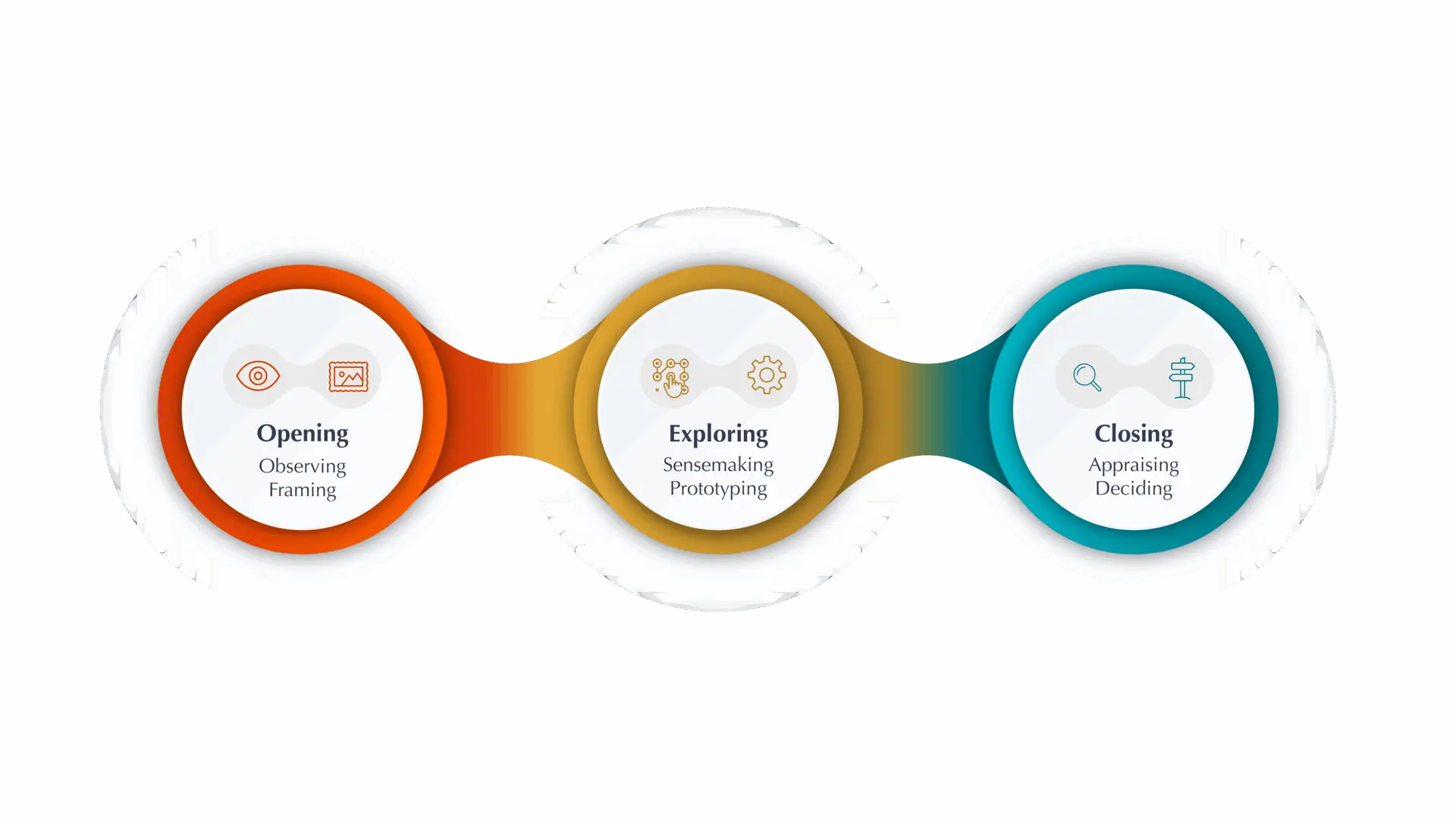
It unfolds in three broad phases — Opening, Exploring, and Closing—each with two distinct moves. This is key: by making those phases explicit, FieldSense helps teams align — not just on the issue, but on where they are in the problem-solving journey.
One of the biggest sources of cross-talk and confusion in senior teams is that people often work from different phases of a problem-solving process without realising it. Some are still trying to understand what’s happening, while others are already leaping to solutions. Still others are evaluating risks and wanting to decide.
They aren’t wrong; they’re simply at different stages. Because that isn’t recognised, the conversation deteriorates.
FieldSense helps name where the team is, what the job is at that stage, and what comes next. That clarity alone often leads to a more structured, focused, and deeper conversation.
PHASE ONE: OPENING
Observing and Framing
The opening phase is about slowing down. Before you leap into action or even begin your analysis, take a moment to stop and orient yourself.
The first move is observing. This involves paying attention to what’s actually happening—not just in the data, but also within the team, the culture, and the system.
In other words, immerse yourself in the field of your enquiry. What’s present? What’s missing? What’s being said — and what isn’t? What’s the quality of energy in the room? What signals are you receiving, even if you can’t quite explain them yet?
Then comes framing. This is where you ask: How are we making sense of what we’re seeing? What kind of issue are we calling this? Is it a technical problem? A trust issue? A capacity gap? A strategic decision? The way you frame the issue will shape every option that follows.
Opening, then, is about engaging with the terrain mindfully — not hurrying to draw the map before you’ve surveyed the landscape.
Here’s an example of a team that used FieldSense to open up to an issue they were experiencing.
The executive team noticed that shareholders—who had long supported their transformation plans—were now pushing for short-term results and questioning assumptions they once accepted. Initially, it felt like a loss of trust.
However, reflecting on what they were observing longer, helped the team frame it not as a vote of no confidence but as a signal that rising external uncertainty was reducing their stakeholders’ tolerance for ambiguity.
Can you see how being more thoughtful about what the team was observing allowed them to shift how they framed it and the way taking more time to do would have a radical impact on what they held open as possible ways forward?
This example shows the team:
- Slowing down to sense the shift
- Withholding premature judgment
- Framing the problem in a more systemic, less defensive way
- Creating new ground for a better conversation
Can you think of a time when your team observed something and was perhaps too quick to agree on what was actually being observed and how the issue was framed? And what possibilities were closed off by this initial positioning?
In the example I’ve just shared, slowing down to be more considered in the very early stages changed how they approached the next conversation: less reassurance and more clarity on what could flex and what was fixed. It was a case of slowing down to speed up.
PHASE TWO: EXPLORING
Sensemaking and Prototyping
Once the team begins to develop a shared sense of what is happening, they move into Exploring. With the two moves of Sensemaking and Prototyping.
First is Sensemaking — which is not the same as analysis. It’s about interpreting complexity together, bringing different views into the room, surfacing patterns, naming tensions, and challenging each other’s thinking — safely.
You’re not trying to agree on anything at this point. You’re trying to understand.
Next is Prototyping, where the team begins testing small responses. You don’t leap from insight to a grand solution; instead, you try something, make a move, and treat action as inquiry.
In practice, that might mean piloting a new way of meeting, reworking how decisions are made, or testing a story with a small group. It involves experimenting with approaches to observe how the system responds, offering further insight into the issue and the system’s reaction to it. It’s a way of learning in motion—not waiting for certainty before you act.
When teams aren’t clear that they are in the Exploring phase, it is easy to misinterpret what is happening. One person’s exploratory idea may sound like a firm proposal, while another person’s desire to move may feel like rushing. By naming the phase, FieldSense helps the team stay grounded in what this moment signifies.
Let’s explore how this works with the same team as before, picking up their shareholder issue.
In this case, the exec team gathered different perspectives: The CFO raised concerns about macroeconomic volatility. The CPO noted a rise in internal unease — people weren’t sure if the transformation was still on track. Chief Strategy Officer observed that their story to the market hadn’t evolved in 18 months, even though conditions had changed.
Together, they surfaced a deeper insight: the issue wasn’t just investor impatience. It was a growing mismatch between the narrative the team was telling and the reality they were operating in. Their strategy hadn’t lost credibility — it had lost alignment with the world around it.
From there, the team moved into Prototyping — not a grand pivot, but a small, focused response to learn more.
They didn’t rewrite the entire strategy. Instead, they revised one slide — the framing of the transformation — and tested it with two key shareholders on the Board. The response was instant: more engagement, more questions, more belief.
That one shift — based on careful sensemaking and a light-touch prototype — told the team something important: they didn’t need to change the substance of their strategy. They just needed to communicate it differently, in a way that matched the moment.
Appraising and Committing
The final phase involves sense-checking and decision-making.
Appraising is a pause. It’s an opportunity to ask: What have we learned? What new risks have surfaced? What feels more true now than at the start?
It’s a moment for the team to reflect on their journey so far and to assess whether the original framework still applies or if something deeper has emerged.
And then — and only then — comes committing. The team makes a shared, conscious decision about what to do next.
What are we actually ready to carry forward? How will we hold this decision? Who needs to be involved?
This is where clarity, alignment, and follow-through come into play. However, these can only occur when the team has travelled the path together — not in parallel, but with a shared awareness of where they’ve been and where they are now.
After testing the reframed investor narrative and seeing positive responses, the team moved into the Closing phase — where they needed to make sense of what they’d learned and decide what to do next.
Appraising meant stepping back to weigh their next move. They surfaced two clear options:
- One was to develop a formal shareholder education campaign — briefing key investors in a more structured way, inviting feedback and building buy-in.
- The other was to take the revised narrative directly into the next Board meeting and position it as a reset — signalling confidence and a more decisive tone.
Both options had merit, but also risks. The first offered inclusivity and learning; the second offered clarity and momentum. The team paused to ask: What’s the signal the organisation — and the market — most needs from us right now?
That led them to Committing.
They agreed to take the revised narrative to the Board — with confidence — but pair it with a commitment to run a focused series of investor conversations in the following weeks. It was a hybrid move: assertive, but not closed.
Crucially, they didn’t just commit to what to do. They committed to how they’d show up in doing it: clearer, more aligned, and more willing to stay in dialogue — with each other and with their stakeholders.
WHY THIS MATTERS
Why does all of this matter?
Too often, senior teams get stuck in what I call performance posture — trying to appear decisive, efficient, and aligned — when the real work would benefit from a slower, deeper, and more systemic conversation.
FieldSense provides teams with the permission — and structure — to do that.
It helps them recognise what’s truly happening, remain engaged in dialogue long enough for insight to surface, and take action with increased alignment and integrity.
It helps them avoid false starts, rework, blame spirals, and one-size-fits-all solutions.
Mostly, it helps reveal one of the biggest causes of ineffective conversations: when different team members are at different stages of the work, but no one acknowledges it.
FieldSense makes the unseen structure visible — enabling the team to work in sync, delve deeper, and progress with a shared understanding.
The team example I’ve shared in this episode didn’t just resolve a moment of tension — they deepened their understanding of the field they were operating in.
By slowing down, thinking together, and staying close to the signals, they moved forward with more trust, more alignment, and a renewed sense of strategic focus.
So that’s FieldSense: a practical framework designed to support senior teams in effective thinking — particularly when the terrain is shifting, the issue is complex, and the pressure is on.
It’s made up of three phases — Opening, Exploring, and Closing — and six simple moves:
- Observing
- Framing
- Sensemaking
- Prototyping
- Appraising
- Committing
It’s not a checklist. It’s a discipline. A shared practice of executive leadership to stay with the messy stuff, to tune in and trust what the field is trying to show you.
If this has inspired you — or if you’d like a visual guide or facilitation resource to help integrate FieldSense into your own team — you’ll find more in the show notes.
And as always, thank you for listening.

By Jacqueline Conway…
Dr Jacqueline Conway works with CEOs and executive teams as they fully step into their collective enterprise-wide leadership, helping them transform their impact and effectiveness.
Jacqueline is Waldencroft’s Managing Director. Based in Edinburgh, she works globally with organisations facing disruption in the new world of work.