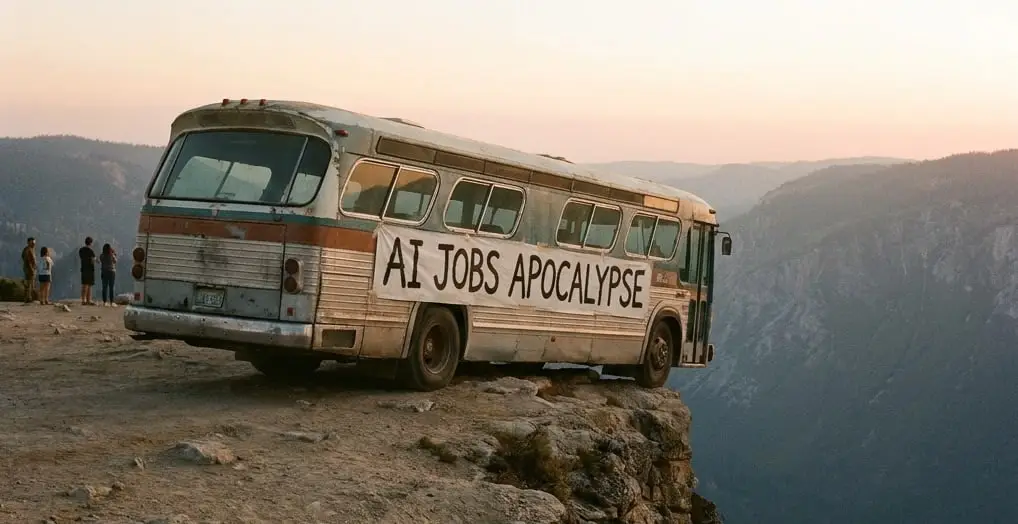
It seems you can't swipe a screen these days, but you're confronted with news of the impending AI jobs apocalypse.
Entry-level jobs are disappearing faster than you can get a graduate to make you a Caramel Frappuccino.
And mid-career professionals are keeping their heads down lest they are disappeared – replaced overnight by an obnoxious, hallucinating AI manager telling their former direct reports they can't take annual leave in July.
We may all lament that we live in a sorry old world, but in many ways it's simply a wolf in new clothes. We've been here before. The question is, do we learn the lesson this time?
It's like that family in Coleman, Texas, who were considering how to spend the day together. The father-in-law suggests a meal in the town of Abilene. So, off they all go, for a 53-mile drive in the sweltering heat for a lacklustre meal that no one enjoyed.
When they get home, exhausted, grumpy and wilting, someone finally admits they hadn't wanted to go. Then another. Then another. It turned out nobody had wanted to go. So how did they end up in Abilene?
Crazy, right?
Back in 1974, management theorist Jerry Harvey called this the Abilene Paradox. The paradox is that groups can take collective action that contradicts everyone's actual preferences because each individual assumes they're the only one with doubts. Everyone stays silent to avoid disrupting what they believe to be consensus.
When a group of people, in any guise, be it a team, an organisation, or even a society, don't engage in proper dialogue about what they want and the implications of the decision, they can end up with collective action that goes against everyone's actual preferences.
We have the blueprint for this with social media. What sane person would have signed up for a society where our children have access to the most brutal and extreme content online that's algorithmically designed to both cause harm and create addiction?
Yet here we are.
Right now, leadership teams across the world are boarding a bus towards an AI-driven future that many of them privately have doubts about. Nobody designed the journey. Nobody voted for the destination. But here they are, rolling, rolling, rolling.
The social and competitive pressure to be seen to be moving in the direction everyone else is heading makes it feel impossible to ask whether this is actually the right road.
Every partner in today's law firms know that AI can do entry-level legal work just as well as junior lawyers, at a tiny fraction of the cost. They also know their competitors know this, so they will all feel competitive pressure to realise those savings.
But they also know that inexperienced lawyers only become experienced by doing the time-consuming, painstaking work of learning by doing. This is another cliff-edge that will inevitably follow cutting off your professional pipeline at the first rung.
These lawyers might want to pay attention to the experience of the 'first movers' in HR who have adopted AI within the people function.
A CareerMinds Survey, published in People Management magazine in March this year, said that a whopping 92% of HR professionals who had gone through an AI restructuring said they'd do it differently if they were to do it again. More than half (52%) were now rehiring roles they had let go.
What a huge waste of energy, talent and goodwill.
Perhaps you and your team are now under pressure to deliver some of the benefits that AI promises? And maybe you don't quite know where to start?
There are some questions you may want to ask yourself as you consider an AI future for jobs across the organisation and in the structure of the people function. They could be:
- Do we need to be at the vanguard of this, or would a more deliberate, iterative approach reduce the risks whilst still delivering the upside?
- Are the decisions we're considering consistent with our values and with what we say about how we want to be in the world?
- What organisation does this actually create, and is this a world we want to be part of?
The stories of those companies that rushed into an unquestioned AI future are filling many column inches of the business press.
This week, the FT reported that the law firm Pinsent Mason was reprimanded by the High Court in London after its lawyers made false submissions to a judge based on AI.
Last week, in the FT, it was EY who were making the news after they were forced to retract a research study that contained AI hallucinations, used made-up data, and misattributed citations.
Oops.
Both of these cases demonstrate the real risk to a company's commercial success and reputation when it adopts tools without proper oversight and foresight.
We're being told this is a FAST game and that we have to move quickly to get ahead. But ask yourself: WHO is saying this? And what's in it for them if you go fast?
[Hint: follow the money.]
It may prove that a more cautious and deliberate approach is best.
Not just to get the implementation right. But to establish if what you're implementing is leading you to the world that you want.
FIND OUT MORE
This is exactly why we created Creating Futures. It's a structured, facilitated process and space where leadership teams can pause, look up, and have the conversations they're not having in day-to-day work. What do we actually want? What are we prepared to be responsible for? Where are we going, and why are we continuing with something we haven't consciously chosen?
This Friday, my client and collaborator Patrice Browne, People Strategy Director at Scottish Power, is joining me for an In Dialogue session to explore exactly these questions in the context of AI and the future of work. If any of this has landed for you today, I'd love you to join us.

By Jacqueline Conway…
Dr Jacqueline Conway works with CEOs and executive teams as they fully step into their collective enterprise-wide leadership, helping them transform their impact and effectiveness.
Jacqueline is Waldencroft’s Managing Director. Based in Edinburgh, she works globally with organisations facing disruption in the new world of work.